







I Built a Self-Care Menu for Bad Days
Some days don’t need a routine.
They need an escape hatch.
I learned this after trying to follow perfectly sensible self-care advice on days when I had absolutely no interest in being sensible. Drink water. Exercise. Journal. Meditate. Call a friend. Sleep earlier. Eat something nutritious.
Fine.
But what if I’m exhausted, irritated, lonely, overstimulated, and staring at the wall at 4:17 p.m.?
A 12-step wellness routine isn’t going to happen.
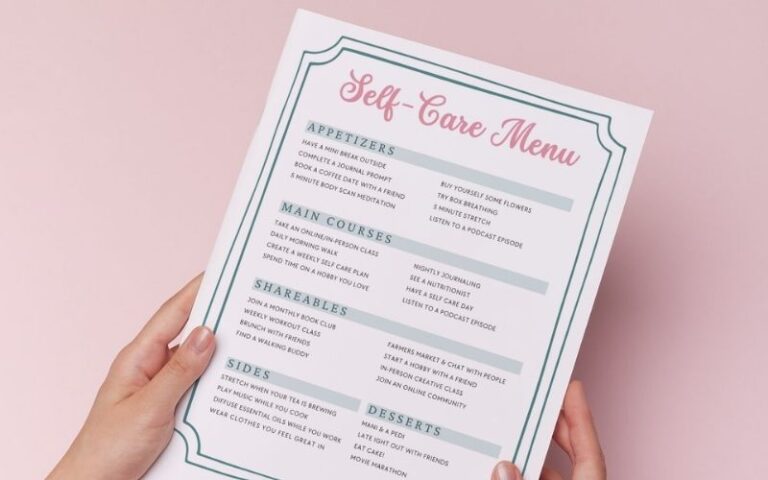
So I built something different: a self-care menu for bad days. Instead of one ideal routine, I keep a short list of options sorted by what I actually need and how much energy I have available.
It has become one of the most practical forms of self-care I’ve used.
And it fits a useful gap in the usual advice. SelfCare Insights already covers routines, mindfulness, burnout, digital detox, boundaries, sleep, and general emotional well-being. This isn’t another “wake up at 6 a.m. and transform your life” guide. It’s a decision tool for the messy middle: what can I do right now when I don’t feel like doing much at all?
Why a self-care menu works better than a perfect routine
Bad days shrink your decision-making capacity.
You know you should do something. The problem is choosing what.
Should you go outside? Take a shower? Text someone? Lie down? Make food? Put your phone away? Cry for ten minutes? Draw something stupid?
That’s where a menu helps.
Instead of asking, “What is the best self-care practice?” I ask:
“What kind of care do I need right now?”
That distinction matters.
The National Institute of Mental Health recommends basics such as regular movement, healthy meals, adequate sleep, relaxing activities, meaningful connection, and setting manageable priorities. It also explicitly acknowledges that self-care looks different for different people and may take trial and error to figure out.
My menu takes that idea one step further.
It doesn’t tell me what I should do. It gives me somewhere to start.
My five-part bad-day self-care menu
I keep five categories because they’re broad enough to cover most rough afternoons without turning self-care into homework.
| If I feel… | I choose from… | Time needed |
|---|---|---|
| Overstimulated | Quiet | 5–30 min |
| Drained | Restore | 5–60 min |
| Stuck in my head | Create | 10–45 min |
| Lonely | Connect | 2–30 min |
| Restless or frustrated | Move | 5–30 min |
The categories aren’t diagnoses. They’re shortcuts.
Sometimes I pick the wrong one. That’s fine. The menu is there to reduce friction, not produce perfect results.
1. The Quiet Menu
This is for the days when everything feels too loud.
Not just noise. Notifications. Conversations. News. Open browser tabs. Someone asking, “What’s wrong?” for the third time.
My quiet options are deliberately boring:
- Put my phone on Do Not Disturb for 20 minutes.
- Sit somewhere with low light.
- Take a shower without playing a podcast.
- Make tea and drink it slowly.
- Lie down with an eye mask.
- Spend ten minutes doing absolutely nothing productive.
- Go outside without headphones.
That last one surprised me.
I used to fill every walk with a podcast or playlist. Now, occasionally, the absence of input is the point.
Relaxation techniques and slow breathing have evidence behind them for stress management, and NCCIH notes that practices such as deep breathing, progressive muscle relaxation, mindfulness, and guided imagery can support the body’s relaxation response.
The trick is not turning “relax” into another performance.
No perfect breathing technique required.
Just less input.
2. The Restore Menu
Sometimes the problem isn’t emotional.
I’m simply running on fumes.
My restore menu is intentionally physical:
Water. Food. Shower. Sleep.
That’s it.
If I’ve skipped lunch and spent six hours staring at a screen, I don’t need an inspirational quote. I need carbohydrates and a glass of water.
If I’ve slept badly, I don’t schedule a massive personal-growth session at 9 p.m. I lower the bar and protect bedtime.
The CDC’s current stress guidance similarly puts ordinary foundations near the center of healthy coping: adequate sleep, regular movement, nutritious food, relaxation, breaks from overwhelming information, and connection with other people.
I also keep “minimum viable hygiene” on this menu.
Brush teeth.
Wash face.
Change clothes.
Done.
On a genuinely bad day, those tiny actions can be the entire assignment.
3. The Creative Menu
This is my favorite category.
It’s also the one I underestimated.
Creative self-care doesn’t mean I have to produce something beautiful. Quite the opposite. The best activities are often gloriously pointless.
I’ll:
- Fill a page with terrible doodles.
- Rearrange photos on my phone.
- Make a ridiculous playlist.
- Bake something simple.
- Take five photographs of ordinary objects.
- Rearrange a shelf.
- Write one page beginning with “Today was weird because…”
- Color without trying to stay inside the lines.
- Make a collage from old magazines.
- Learn a tiny piece of a song.
The goal isn’t productivity.
The goal is participation.
That distinction changes everything.
There is substantial research behind the broader idea that arts engagement can contribute to health and well-being. A World Health Organization review examined more than 3,000 studies across a wide range of artistic activities and found evidence of roles for the arts in health promotion, prevention, and management of illness.
That doesn’t mean doodling cures a bad mood.
It means creativity deserves a place in a serious self-care toolkit.
And sometimes making an ugly little drawing is easier than trying to “process my emotions.”
4. The Connection Menu
Isolation can make a bad day feel much bigger.
The annoying part? When I’m feeling awful, initiating contact can feel like work.
So my connection menu contains low-effort options, not just “call your best friend and have a deep conversation.”
I might:
- Send someone a photo with no explanation.
- Text, “Rough day. Don’t need advice. Just saying hi.”
- Send a voice note.
- Sit near other people without needing to talk.
- Ask someone if they want to take a short walk.
- Reply to one message I’ve been avoiding.
That “no advice” text has been particularly useful.
People sometimes want companionship, not troubleshooting.
Research from the CDC consistently points to social connection as an important part of mental and physical well-being, while supportive relationships can help people cope with stress and difficult circumstances.
Connection doesn’t have to be dramatic.
Sometimes it’s a two-minute exchange about someone’s dog.
Good enough.
5. The Move Menu
This category has one important rule:
Movement does not have to mean exercise.
On a good day, maybe I’ll go for a 30-minute walk.
On a bad day, I might stretch beside the bed for four minutes.
Both count.
My menu includes:
- A five-minute walk around the block.
- Gentle stretching.
- Dancing to one song.
- Walking while making a phone call.
- Tidying one small surface.
- Standing outside for fresh air.
- A slow, aimless walk with no step-count target.
NIMH notes that even small amounts of physical activity can add up, while the CDC similarly recommends starting small and building gradually rather than treating exercise as an all-or-nothing task.
That’s useful on bad days because “exercise” can sound enormous.
“Walk to the end of the street” doesn’t.
The secret: make every option smaller than you think
My first version of the menu failed.
It was full of admirable ideas.
Thirty-minute yoga session. Cook a nourishing dinner. Journal for twenty minutes. Meditate. Go for a long walk. Read a chapter. Declutter the bedroom.
Lovely.
Completely useless when I was already depleted.
So I rewrote everything as a minimum version.
Instead of:
Journal for 20 minutes.
I wrote:
Write three sentences.
Instead of:
Meditate.
I wrote:
Sit quietly and take five slow breaths.
Instead of:
Exercise.
I wrote:
Walk outside for five minutes.
Instead of:
Connect with friends.
I wrote:
Send one honest text.
This makes the menu executable.
And once I’m moving, I can always do more.
I also added a “do absolutely nothing” option
This sounds like cheating.
It isn’t.
Rest and avoidance aren’t always the same thing.
If I’ve spent a brutal day dealing with deadlines, conflict, noise, and constant demands, deliberately lying on the couch for 20 minutes can be a reasonable choice. The problem comes when “rest” turns into hours of scrolling while feeling progressively worse.
That’s why I give passive activities a boundary.
Twenty minutes of television? Fine.
An hour of endless doomscrolling? Probably not the care I was looking for.
The CDC specifically recommends taking breaks from news and social media when constant exposure becomes upsetting.
My rule is simple: afterward, do I feel slightly more like myself?
If yes, keep it.
If no, choose another item.
How I use the menu when I can’t decide
On particularly bad days, I use a three-question filter.
First: What is the loudest problem?
Hungry? Lonely? Overstimulated? Restless? Exhausted?
Second: How much energy do I actually have?
Almost none? Five minutes? Enough for something mildly active?
Third: What is the smallest helpful action?
That’s the one I choose.
Not the most impressive.
Not the most optimized.
The smallest helpful one.
A real example
Imagine it’s 6:30 p.m. I’ve had a miserable day, haven’t eaten properly, and I’ve been doomscrolling for an hour.
The old approach would be: “I need to fix my evening.”
The menu approach is different.
Restore: eat something simple and drink water.
Quiet: put the phone somewhere else for 15 minutes.
Move: step outside for five minutes.
That’s enough.
Maybe I feel better afterward. Maybe I don’t.
Self-care isn’t a vending machine where you insert a breathing exercise and receive happiness.
It’s support.
Build your own menu in 10 minutes
Open a note on your phone or grab a piece of paper.
Create five headings:
- Quiet
- Restore
- Create
- Connect
- Move
Then add three tiny actions under each.
Don’t add 20.
The whole point is that your future exhausted self shouldn’t have to scroll through a giant productivity database to find something helpful.
I’d also add one personalized section:
“Things that reliably make me feel human again”
Mine might include a particular album, a certain walk, fresh sheets, drawing, sitting in sunlight, or talking to one specific person.
Yours will be different.
That’s the beauty of the menu.
It belongs to you.
FAQ: Self-Care Menu for Bad Days
What is a self-care menu?
A self-care menu is a pre-made list of small activities you can choose from based on your emotional state, energy level, or immediate needs. Unlike a fixed routine, it gives you options instead of prescribing one schedule.
What should I put on a bad-day self-care menu?
Start with basics: food, water, sleep, quiet, movement, creativity, and connection. Then add highly personal activities that reliably make your environment or mood feel a little easier.
How many activities should be on the menu?
Start with around 15 total—three options across five categories. A short menu is easier to use when you’re tired, stressed, or overwhelmed.
Does self-care have to involve exercise or meditation?
No. Those can be useful tools, but they’re not requirements. Creative activities, social connection, rest, hobbies, time outdoors, and ordinary practical care can all have a place in a self-care plan.
What if bad days keep happening?
A self-care menu is a coping tool, not a substitute for professional support when distress becomes persistent or seriously interferes with everyday life. NIMH recommends seeking professional help for severe or distressing symptoms that persist for two weeks or more, particularly when sleep, concentration, daily functioning, or interest in normal activities are affected.
Make the menu before you need it
The best time to build a bad-day menu is not during a bad day.
It’s now.
Ten minutes. One note. Fifteen tiny options.
Then, the next time everything feels like too much, you won’t have to invent a solution while running on empty.
You’ll already have one.
And if I could change just one thing about the way we talk about self-care, it would be this: stop designing it only for our best days.
Build something your tired, irritated, unmotivated, slightly overwhelmed self can actually use.
Put it somewhere easy to reach.
Then make the first option ridiculously small.
That’s usually where I start.
