







Why Your Sleep Tracker Says You Slept Well
You wake up feeling like you barely slept. Your tracker disagrees.
Last night, according to your watch or ring, you logged 7 hours and 42 minutes. Sleep efficiency looked excellent. Deep sleep was “good.” Your score landed in the 80s or 90s. Maybe you even got a cheerful little badge.
And yet you feel wrecked.
That mismatch isn’t necessarily a software bug. It comes from a basic fact that’s easy to forget: your sleep tracker doesn’t actually watch you sleep in the way a sleep laboratory does.
It estimates.
That distinction matters for brain health, especially if you’re using sleep data to make decisions about stress, recovery, focus, mood, or daily performance.
Your tracker isn’t measuring sleep directly
A clinical sleep study, or polysomnography (PSG), can record brain activity through electroencephalography (EEG), eye movements, muscle activity, breathing, heart activity, and other physiological signals.
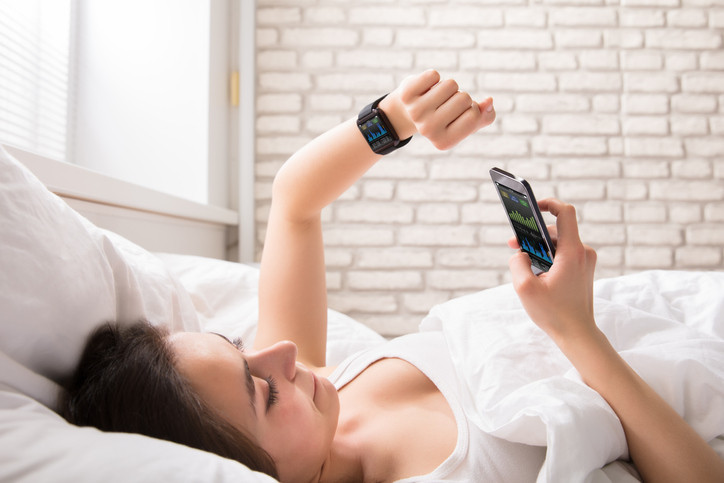
Your Apple Watch, Fitbit, Garmin, Oura Ring, or WHOOP doesn’t have that full laboratory setup.
Instead, consumer devices typically combine signals such as movement, heart rate, heart-rate variability, skin temperature, and other measurements. Algorithms then estimate whether you’re awake or asleep and, depending on the device, estimate stages such as light, deep, and REM sleep.
Oura, for example, says its Sleep Score incorporates sleep stages alongside resting heart rate, body temperature, movement, sleep efficiency, latency, timing, and other contributors.
That’s sophisticated technology.
It still isn’t an EEG.
And that explains a surprisingly large part of the “I feel awful, but my sleep score says excellent” problem.
The biggest issue: lying still can look like sleeping
Here’s the annoying bit.
Suppose you wake at 4:40 a.m. You don’t reach for your phone. You don’t get out of bed. You simply lie there, eyes open, thinking about tomorrow.
Your body isn’t moving much.
A movement-based sleep algorithm may have a hard time distinguishing that period from actual sleep. Research on consumer wearables has repeatedly found a pattern of high sensitivity for detecting sleep but lower specificity for detecting wakefulness. In plain English, these devices can be good at recognizing that you’re probably asleep, while struggling more with quiet periods of wakefulness.
So your tracker might report:
7h 31m asleep
while your lived experience feels more like:
6h 45m asleep + 46m of exhausted staring into darkness.
That difference can matter.
A 2025 meta-analysis covering 24 studies and 798 participants found statistically significant differences between consumer wrist-worn trackers and polysomnography for total sleep time, sleep efficiency, sleep latency, and wake after sleep onset. The authors concluded that these devices remain useful for observing general patterns but aren’t equivalent to PSG.
Your tracker can be directionally useful without being literally correct.
That’s the better mental model.
“Good sleep” is usually a composite score
Another source of confusion is the number itself.
A sleep score looks objective. It isn’t a direct measurement of “how restorative your sleep was.”
It’s an algorithmic summary.
Oura currently describes its Sleep Score as a combination of factors including total sleep, efficiency, restfulness, REM sleep, deep sleep, latency, and timing. WHOOP’s current Sleep Performance system incorporates sleep sufficiency, consistency, efficiency, and sleep stress.
Different products can therefore give different answers to the same night.
Imagine you slept for 7 hours and 50 minutes but woke up repeatedly. One platform might emphasize your total sleep and schedule consistency. Another might weigh sleep stress or efficiency differently.
Same human.
Different algorithm.
That’s why comparing a “92” from one device with an “82” from another isn’t particularly meaningful.
Your sleep stages are educated estimates, too
Deep sleep gets a lot of attention because it sounds like the premium version of sleep.
Then there’s REM.
Then light sleep.
The colored timeline looks wonderfully precise.
But don’t mistake visual precision for biological precision.
Traditional sleep staging in PSG uses EEG alongside eye and muscle measurements to classify sleep into stages. Consumer wearables generally infer those stages from indirect signals. A 2024 systematic review found moderate accuracy for some devices, while also concluding that specific sleep-stage estimates still need improvement.
A 2025 meta-analysis reached a similar conclusion: consumer wrist devices differed from PSG across several sleep measures and weren’t consistently reliable enough to replace laboratory assessment.
So if your ring says you had 1h 37m of deep sleep, don’t interpret that as a brain scan showing exactly 97 minutes of stage N3 sleep.
Think of it as an algorithmic estimate.
That distinction becomes especially important if you start obsessing over tiny nightly changes.
Why you can feel terrible after a “great” night
Sleep quantity is only one piece of the experience.
You might have spent enough time asleep while still dealing with fragmented sleep, an unusual schedule, stress, illness, alcohol, environmental disruption, or simply a night that didn’t feel restorative.
There is another wrinkle: the way you feel after waking isn’t necessarily a perfect readout of the entire night’s sleep either.
Sleep inertia can temporarily make you feel foggy or sluggish after waking. If your alarm catches you at an inconvenient point in your sleep period, the first 20 or 30 minutes of the morning can feel disproportionately awful.
Then there’s the previous day.
WHOOP, for instance, incorporates factors such as sleep debt, prior strain, naps, and baseline sleep into its personalized Sleep Need calculation.
Your brain doesn’t reset at midnight.
Your sleep is part of a longer biological story.
Brain health needs trends, not bedtime perfection
This is where sleep trackers can become genuinely useful.
Don’t ask:
“Was last night perfect?”
Ask:
“What keeps happening?”
A single night with 52 minutes of deep sleep doesn’t tell you much.
Three months of data showing that your sleep duration repeatedly falls short on work nights? Much more interesting.
A recurring pattern of late bedtimes followed by short sleep? Useful.
A consistent difference between nights when you exercise and nights when you don’t? Worth investigating.
The tracker becomes a behavioral instrument rather than a nightly judge.
That approach also fits the evidence better. Research suggests wearables can provide reasonable estimates for broad sleep metrics and longitudinal self-tracking, even though their variability limits their use as standalone diagnostic tools.
Try this two-week experiment
For 14 nights, record:
- Tracker data: total sleep, bedtime, wake time, efficiency, and whatever sleep score your device provides.
- Your own experience: morning energy, concentration, mood, and whether you woke during the night.
Don’t change five things at once.
After two weeks, look for relationships rather than perfect numbers.
You may discover that an 88-score night feels fantastic.
You may also discover that your “95” nights often follow late dinners, restless mornings, or an irregular schedule.
That’s valuable information.
The device itself can introduce weird results
Real-world tracking isn’t performed in a laboratory.
Your watch can be loose.
Your ring can rotate.
Your sensor can lose contact.
You might remove the device to charge it and forget to put it back on. Your bedtime may be detected incorrectly after reading in bed. A late nap can be classified strangely. Travel across time zones can make timing data look bizarre.
And yes, sometimes the obvious explanation wins.
Your tracker can’t analyze data it didn’t collect.
Before worrying about a strange sleep graph, check the boring stuff:
- Is the device fitted according to the manufacturer’s guidance?
- Was it worn consistently?
- Did you charge it overnight?
- Did you manually edit an obvious mistake?
- Did your bedtime or wake time change dramatically?
- Did you sleep somewhere unusually hot, cold, noisy, or unfamiliar?
Small errors can create surprisingly convincing charts.
Don’t chase deep sleep like it’s a high score
This may be the most useful habit to adopt.
If your tracker reports 58 minutes of deep sleep one night and 1 hour 24 minutes the next, resist the urge to “fix” the difference immediately.
Sleep architecture naturally varies.
And the consumer device isn’t measuring brain waves directly anyway.
The danger is that a health tool becomes a source of anxiety. You start checking the app before you’ve even noticed how you feel. A mediocre score ruins your morning. A high score reassures you despite obvious fatigue.
That’s backwards.
Your tracker should inform your judgment, not replace it.
When the numbers and your body disagree
Use a simple hierarchy.
| Signal | What it can tell you | How to use it |
|---|---|---|
| Sleep duration | How much time you probably slept | Watch the long-term pattern |
| Sleep timing | Whether your schedule is consistent | Look for recurring shifts |
| Sleep efficiency | Estimated sleep versus time in bed | Useful as a trend |
| Sleep stages | Algorithmic estimates | Avoid obsessing over single nights |
| Morning energy | Your actual lived experience | Take seriously |
| Daytime sleepiness | Functional impact | Track recurring problems |
| Repeated symptoms | Possible persistent sleep issue | Consider professional evaluation |
That last category matters.
If you’re consistently exhausted despite apparently adequate sleep, don’t let a shiny score convince you that nothing is wrong. A wearable isn’t designed to rule out every cause of poor sleep, and its limitations are precisely why clinical assessment still has a role.
FAQ: Why does my sleep tracker say I slept well when I didn’t?
Because the device estimates sleep from indirect signals and may classify quiet wakefulness as sleep. Its score also combines multiple metrics according to a proprietary algorithm. A high score doesn’t necessarily mean you subjectively experienced a restorative night.
Can a smartwatch accurately measure deep sleep?
Not with the precision of laboratory polysomnography. Some consumer devices can estimate sleep stages reasonably well, but research continues to find differences between wearable estimates and PSG measurements. Treat deep-sleep numbers as trends rather than exact measurements.
Should I trust my sleep score?
Trust it as one data point, not as the final verdict. Look at several weeks of information and compare the numbers with your daytime alertness, mood, concentration, schedule, and habits.
Why does my tracker show almost no awake time?
Quiet wakefulness is one of the harder problems for movement-based sleep tracking. If you’re awake but barely moving, the algorithm may interpret some of that period as sleep. Research has documented this general limitation across consumer wearables.
What if I feel tired even though my tracker consistently says I sleep well?
Don’t automatically blame the tracker—or yourself. Check the broader pattern, including sleep duration, timing, awakenings, daytime sleepiness, and other factors affecting how you feel. Persistent or significant sleep problems deserve attention beyond what a consumer wearable can provide.
Use the tracker as a compass, not a courtroom
A sleep tracker can be remarkably useful.
It can expose patterns you’d otherwise miss. It can show that your bedtime drifts by an hour on weekends, that your sleep duration collapses after late nights, or that your routine has quietly changed over several months.
But the number on the screen isn’t your brain.
It’s an estimate generated from sensors, algorithms, assumptions, and whatever data your device managed to capture that night.
So tomorrow morning, check the score if you want.
Then check yourself.
If the two disagree once, keep watching. If they disagree for weeks, the mismatch itself becomes useful information—and that’s a much better reason to track your sleep than trying to earn a perfect score.