






My Low-Waste Bath Routine Changed More Than Expected
The first thing I noticed wasn’t the trash.
It was the clutter.
Half-used shampoo bottles crowded the shower floor. A nearly empty conditioner bottle somehow survived for another three months. Cotton rounds disappeared by the handful. Then there were the plastic razors, disposable cleaning wipes, tiny toiletry containers, and the occasional product I’d bought because the packaging looked wonderfully sustainable.
My bathroom was supposed to be the easy room.
It wasn’t.
So I started making small changes to my bath routine—not a dramatic zero-waste overhaul, not a shelf full of expensive eco-products. I simply looked at what I used repeatedly, where it came from, how long it lasted, and what happened to it afterward.
That shift changed more than the amount of rubbish in my bin.
It changed how I bought things, how I used water, how much clutter I tolerated, and even how I thought about “sustainable” personal care.
I stopped trying to make the bathroom perfect
The first mistake was assuming low-waste meant replacing everything immediately.
It doesn’t.
The U.S. Environmental Protection Agency puts source reduction—preventing waste before it exists—ahead of recycling in its waste-management hierarchy. Buying less packaging, reusing products, purchasing in bulk, and choosing durable goods all fit that principle.
That gave me a much more useful rule:
Use what you already own. Replace selectively.
I didn’t throw away perfectly usable plastic bottles just because I’d discovered shampoo bars. That would’ve created waste in the name of avoiding waste.
Instead, I finished each product and changed the replacement.
The difference sounds tiny. It isn’t.
Once I stopped treating sustainability like a shopping challenge, the bathroom became noticeably less crowded.
My biggest win was packaging, not recycling
Recycling feels productive because there’s a visible action: rinse container, sort container, put container in the appropriate bin.
But recycling comes after the waste has already been created.
Source reduction happens earlier.
That distinction changed my buying habits.
For products I use frequently, I now ask three questions:
- Can I buy it with less packaging?
- Can I reuse the container?
- Can I buy a concentrated or solid version without creating another problem?
A shampoo bar can eliminate a conventional plastic bottle. A refill pouch can reduce packaging compared with repeatedly buying rigid bottles. A refillable soap dispenser can keep one container in service for years.
But none of these choices gets an automatic sustainability medal.
Transportation, ingredients, manufacturing, packaging materials, product longevity, and disposal all belong in the picture. EPA’s sustainable-materials framework specifically takes a life-cycle view, considering extraction, manufacturing, distribution, use, reuse, and end-of-life management rather than judging a product by one feature alone.
That made me suspicious of simple labels.
“Plastic-free” isn’t the same as low-impact.
“Natural” isn’t the same as sustainable.
And recyclable packaging isn’t the same as packaging that actually gets recycled where you live.
The shower became a little more boring—and better
My current approach is intentionally unglamorous.
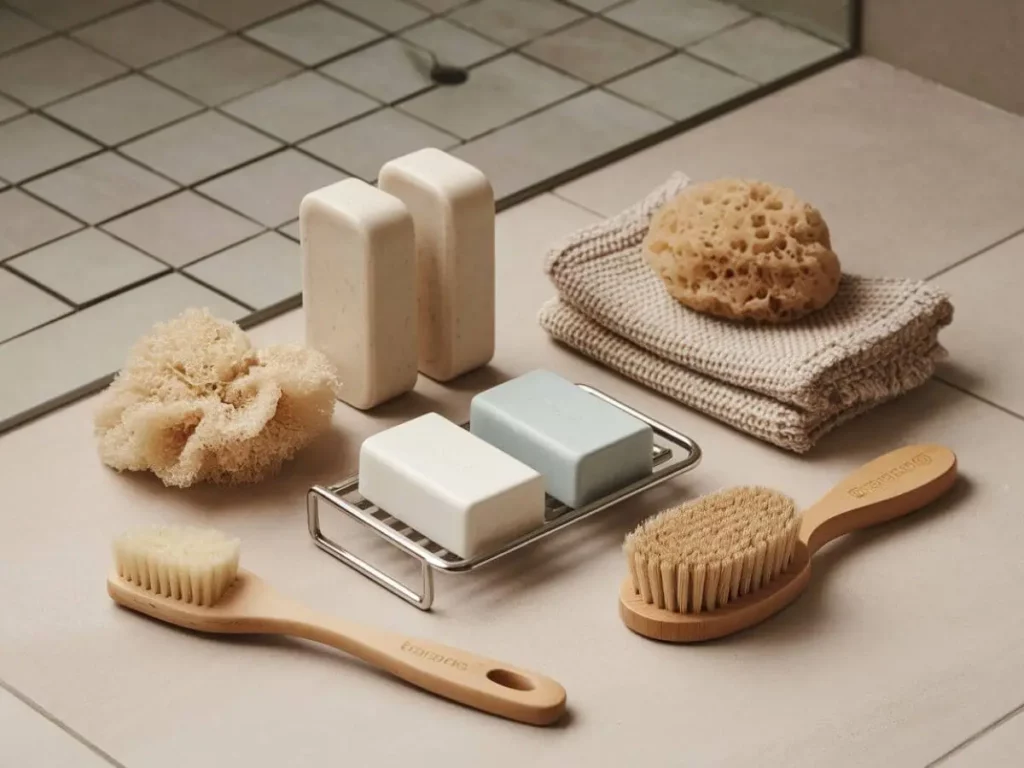
I keep fewer products in the shower and try to finish one before opening another. Soap is stored where it can dry between uses rather than sitting in a puddle. Shampoo and conditioner bars, when they work for my hair, stay on draining dishes instead of dissolving into mush.
That last detail matters more than I expected.
A bar that lasts six weeks is considerably less appealing if half of it disappears down the drain because it never dries.
I also became much less enthusiastic about “travel-size everything.”
Small bottles are convenient, but buying a miniature version of a product I already own isn’t automatically efficient. For travel, I reuse appropriate containers when possible and avoid transferring products unnecessarily.
There are exceptions. Hygiene matters. Product compatibility matters. Some formulations shouldn’t be decanted or mixed.
And that’s where low-waste living gets pleasantly practical.
Water became part of the routine
Packaging gets most of the attention, but the bath itself is a resource-intensive part of the day.
I started noticing how often the water was running while I wasn’t actually using it.
A few small habits stuck:
- Turn off the shower while applying shampoo or conditioner.
- Don’t let water run while brushing teeth.
- Keep showers purposeful rather than treating them as background time.
- Fix dripping taps instead of mentally adding them to the “I’ll deal with it later” list.
- Use only the amount of product needed rather than rinsing excess product away.
None of this requires a bathroom renovation.
The surprising part was psychological. Once I began paying attention to water, I became more aware of the energy and materials surrounding the entire routine.
A low-waste bath isn’t only about the bottle in your hand.
It’s the water, packaging, product quantity, accessories, electricity or fuel used to heat the water, and what remains afterward.
I got more careful about “DIY” beauty
This was one of my less successful experiments.
I initially assumed that making products myself would automatically reduce waste. A homemade mixture in a reused jar sounded wonderfully simple.
Then I remembered that water-based cosmetics aren’t as carefree as a bowl of homemade sugar scrub.
The FDA warns that adding water to cosmetic products can introduce microorganisms and dilute preservatives designed to control microbial growth. Warm, damp storage can also encourage microbial growth, while preservatives may degrade over time.
So I stopped treating the bathroom like a kitchen laboratory.
Dry ingredients are one thing. Formulated personal-care products are another.
If I make something, I keep the formulation simple, make a small amount, store it appropriately, and don’t assume “homemade” means safer or more sustainable.
Sometimes the greener choice is simply using the product that has already been manufactured instead of buying five ingredients and three new containers to recreate it.
I stopped buying “eco” accessories I didn’t need
This might have been the most embarrassing realization.
I could reduce waste while simultaneously creating a lot of shopping waste.
Bamboo this. Reusable that. Special little container for the other thing.
Eventually, the bathroom began accumulating sustainable-looking objects.
That’s not the goal.
A durable item only makes sense if it replaces something disposable or solves a real recurring need. EPA’s consumer guidance similarly emphasizes durability, reuse, recycled content, and buying only where those attributes actually provide a benefit.
So I kept the things that earned their space.
A washable cloth replaced some disposable cotton products. A reusable razor handle made sense because I could replace the blade rather than the entire handle. A sturdy soap dish worked because it extended the life of a product I already used.
Other purchases quietly disappeared from the list.
No guilt required.
The hidden plastic problem changed how I read labels
Personal-care products have another issue beyond bottles: plastic can also appear in formulations.
UNEP has highlighted the presence of plastic ingredients in cosmetics and personal-care products, including materials such as polyethylene (PE), polypropylene (PP), polyethylene terephthalate (PET), nylon, and polymethyl methacrylate (PMMA).
That doesn’t mean every product containing a synthetic polymer is automatically harmful or that every solid product is environmentally superior.
It does mean I stopped equating a minimalist-looking package with the whole environmental story.
Now I look at the actual ingredient list and the manufacturer’s information, particularly for products marketed around exfoliation, glitter, cleansing particles, or “microbead” claims.
The bathroom is a drain-connected room.
What goes down it doesn’t simply vanish.
My low-waste routine now follows a simple hierarchy
After months of trial and error, I’ve ended up with something much less complicated than my original plan.
| Priority | What I do | Why it stays |
|---|---|---|
| 1 | Use what I already own | Prevents unnecessary replacement waste |
| 2 | Buy fewer products | Reduces packaging and clutter |
| 3 | Choose refills, concentrates, or solids when practical | Can reduce packaging |
| 4 | Reuse durable containers and accessories | Extends product life |
| 5 | Recycle what remains through local programs | Handles waste that couldn’t be avoided |
| 6 | Replace products only when there is a real benefit | Avoids sustainability-driven overconsumption |
That order matters.
Recycling is still useful. It just isn’t the first lever I reach for.
The bathroom became cheaper, too
I hadn’t expected this.
Once I stopped buying backups, trend-driven products, novelty scents, and slightly different versions of things I already had, my spending dropped.
Not dramatically every week.
Quietly.
A bottle lasts longer when I’m not opening another one halfway through. A refill makes more sense when I know exactly how much I use. A reusable item pays off when it actually replaces repeated purchases.
There was also less “product fatigue.” I wasn’t standing in front of twelve nearly identical bottles wondering which one was supposed to be used first.
That might sound trivial.
It isn’t.
A sustainable routine has to be easy enough to repeat.
Five low-waste bath changes worth trying
You don’t need to copy my entire routine. Start with the things you already know are wasteful.
1. Finish your existing products
Don’t create a new waste stream by replacing usable products prematurely.
2. Track one month’s bathroom trash
Keep a small note on your phone. Write down what gets thrown away.
The pattern will tell you more than a generic zero-waste checklist.
3. Replace the repeat offenders
If shampoo bottles dominate your waste, investigate bars, concentrates, or refill systems. If disposable wipes are the problem, consider washable alternatives where appropriate.
4. Make products last longer
Keep solid products dry. Close containers properly. Don’t use three pumps when one will do.
Small quantities add up.
5. Check local recycling rules
A package marked “recyclable” doesn’t guarantee that your local system accepts it. Search your municipality’s current guidance before building your routine around a particular material.
FAQs
Is a shampoo bar really more sustainable than bottled shampoo?
It can reduce packaging, especially when sold without plastic, but the answer depends on the product’s ingredients, manufacturing, packaging, transportation, and how efficiently you use it. If the bar melts away quickly in your wet shower, its advantage can shrink.
What’s the easiest low-waste bathroom swap?
Start with something you use frequently and throw away regularly. A reusable razor handle, refillable soap dispenser, washable cloth, or package-light personal-care product can be a sensible first step.
Should I throw away my plastic bottles and switch to zero-waste products?
No. If they’re usable, finish them. Replacing functional products solely to make your bathroom look more sustainable creates additional consumption. The better opportunity usually comes at the next purchase.
Are refill pouches always better than bottles?
Not automatically. A refill can reduce material use, but the whole product system matters. Compare how much product you receive, how the package is handled locally, whether the container can be reused, and what happens to the refill afterward.
Can I make my own bathroom products to eliminate packaging?
Sometimes, but don’t assume homemade means safer or lower-impact. Water-based cosmetic mixtures can have microbial-safety issues, and changing or diluting commercial formulations can interfere with preservatives.
The change I’m making next
I’m not trying to reach a perfectly waste-free bathroom.
That goal became surprisingly exhausting.
Instead, I’m watching what repeatedly enters the bathroom and what repeatedly leaves it. That’s where the useful information lives.
The next time something runs out, I’ll pause before replacing it. Do I actually need it? Can I buy less packaging? Can I refill it? Can I make the existing item last longer?
That tiny pause has become the most useful part of my bath routine.
Start there. Not with a shopping spree. With the next empty bottle.